Saturday, May 4, 2013

May Wonderopolis #WonderChat

Please join the Wonder Team this Monday night, May 6th at 8:00 PM EST on Twitter.  We will be discussing Wonder Jars.  Do you have a Wonder Jar in your classroom?  Come share your ideas!  If you don't, come join the conversation.  We will be discussing easy ways to make Wonder Jars and different ideas to incorporate them into the classroom to extend student thinking and learning.
As the school year is coming to a close, I would like to spend some of the hour reflecting on how teachers have used Wonderopolis in the classroom.  Come share some of the ways you have used Wonder and Wonderopolis in your classroom this year.

I look forward to a WONDERful conversation!  Don't forget to use the hashtag #WonderChat.  See you Monday night at 8:00!


Thursday, April 11, 2013

Using Wonderopolis to Write Found Poetry

We started our found poetry adventure in second grade by visiting Amy Ludwig VanDerwater's found poem, Chicken. I love how Amy explains to students what a found poem is and how she used the passage about chickens to write her found poem.  It was an excellent way to begin the conversation about found poems.

Our second stop in our found poetry adventure was reading some nonfiction passages in Bold and Bright, black-and-white by Dorthy Hinshaw Patent.  I used one of the passages to model creating a found poem and then we created a found poem as a class.  I made copies of the passages in the book and had students work with a partner to create their own found poems.

I believe in writing right along side of my students.  Here is a found poem I created and shared with my students.


Found by Barbara Phillips 
in Bold and Bright, black-and-white
mysterious animal
black-and-white
why?
no one knows why.
All we know is
that we love the way
this animal looks.

Another stop in our found poem adventure was reading many found poems in the book The Arrow Finds Its Mark edited by Georgia Heard.  We read and enjoyed together found poems from many authors including J. Patrick Lewis, Rebecca Kai Dotlich and Amy Ludwig VanDerwater.  Each poem shares where the author found the words for the poem including such places as books, websites, road signs and even Twitter.
Our last stop as a class in our found poem adventure was using Wonder #920 Does Every Rose Have a Thorn?.  As a class we underlined words that we found pleasing, that we might want to try and use in a found poem about roses.  Students then worked on using the words, arranging them into a poem.  Below are a few student created poems.
Found by Andrew
from Wonder #920 Does Every Rose Have a Thorn?
Yellow roses represent friendship.
I like yellow roses.
White roses symbolize purity and sincerity.
I like white roses.
Red roses conveys feelings of romance and passion.
I like red roses
and I always will

Found by Lauren
from Wonder #920 Does Every Rose Have a Thorn?
Nearly thornless,
Prickly danger,
Romance
                          Passion
Red rose.


Found by Anna
from Wonder #920 Does Every Rose Have a Thorn?
Roses have
meaningful
meanings.
The yellow 
represents
friendship
White roses
symbolize
purity and sincerity
and red 
the most
popular
means love

If you would like to virtually meet author and poet Amy Ludwig VanDerwater be sure to join April's Wonderopolis #WonderChat on Monday, April 15th at 8:00 pm EST.  In honor of National Poetry Month Amy will be our special #WonderChat guest.  She will be sharing how to use Wonder to create poetry with children, including strategies and ideas.

Thursday, March 28, 2013

Wonders for National Poetry Month

April is National Poetry Month.  My second graders are writing lots of different kinds of poetry this month, including found poems, mask poems and shape poems.  I hope to share more about their poetry writing in future posts.  Below are Wonders from Wonderopolis that you may want to share in April or during a poetry unit.
#889 What Is a Genre?
#821 What Is a Metaphor?
#766 When Will Pigs Fly? (figure of speech)
#761 Can a Word Be Both a Noun and a Verb?
#750 What Are Spoonerisms? (word play)
#734 What Is a Font?
#724 Do You Like To Play with Words?
#702 Are You Sly as a Fox? (similes)
#575 What Is a Poetry Slam?
#527 Who Is Uncle Sam? (figure of speech/personification)
#482 Have You Ever Been on a Wild Goose Chase? (figure of speech)
#415 What Rhymes With Orange?
#294 Why Do We Use Different Words For the Same Things? (word choice/synonyms)
#221 What Is a Limerick?
#202 What Is a Sonnet?
#169 What Is an Acrostic Poem?
#70 What Is a Haiku?
In celebration of National Poetry Month our Twitter #WonderChat will be on Monday, April 15th at 8:00 pm EST.  The chat will feature Amy Ludwig VanDerwater.  She is the author of a new book, Forest Has a Song.  Amy also has many wonderful poetry resources for teachers on her blog, The Poem Farm.  She will be sharing how to use Wonder in writing poetry and answering any question you may have about writing poetry.

Tuesday, March 26, 2013

Nominating a Wonder in Second Grade


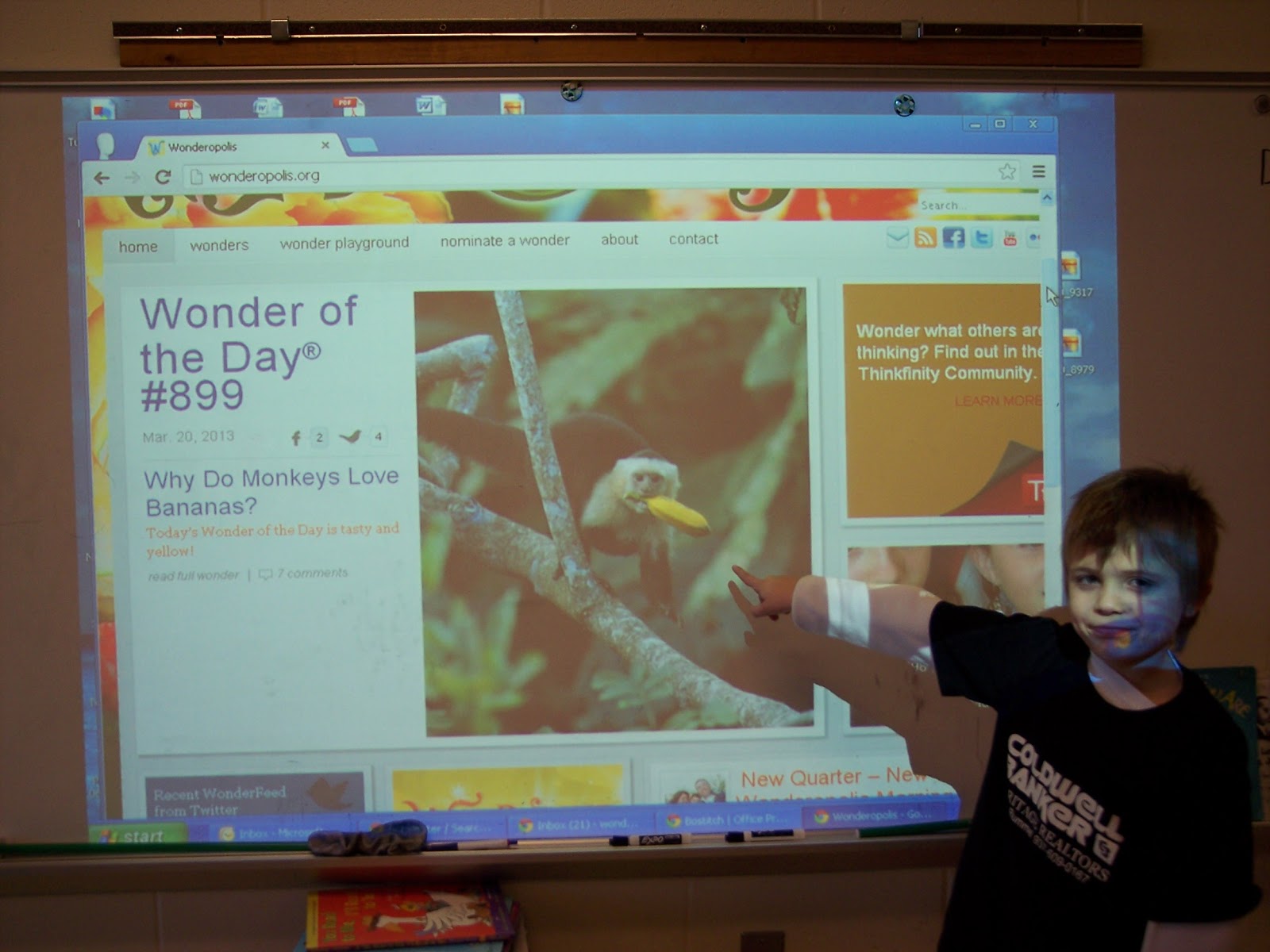
Last Thursday morning as my second grade class came in Wonder #899 Why Do Monkeys Love Bananas? was projected up on the front board.  Avery (pictured above) excitedly came over to tell me that he had nominated the Wonder.  The excitement only continued as we visited the Wonder as a class and found that Avery was credited at the beginning of the Wonder for nominating it.


Wonderopolis does a wonderful job of making kids feel heard and validated.  They respond to comments daily on their website.  Recognizing children for nominating the Wonder of the Day is another example of how they make their audience feel special.  

If you have something you Wonder about, be sure to check the Wonderopolis website to see if it is already a Wonder of the Day.  If it isn't go here and nominate it for a future Wonder of the Day.  You might find your name at the beginning of a future Wonder.

Friday, March 15, 2013

New Quarter - New Wonderopolis Morning Work

I use Wonderopolis as a morning activity in my second grade classroom.  I have used two different student forms this year.  As the third quarter was coming to an end, I began thinking about changing the form that students use when reading the Wonder.  I remembered reading on Twitter about a teacher using the 3-2-1 approach with Wonderopolis.  Specifically she was using the 3-2-1 for homework and commenting.  You can see her class blog about it here.  You will have to scroll down to 1/16/13.  This led me to create my own 3-2-1 form to use in the morning while we reading over the Wonder of the Day.

While reading over the Wonder, we underline important parts or key details in each section of the Wonder.

Below are some students' 3-2-1 forms using Wonder #890 Who Was the First Person in Space?


Sunday, March 10, 2013

Take Me Out to the Ball Game - Baseball Wonders


With spring training in full swing and Opening Day a couple of weeks away, I've compiled some Wonders and ideas for using the Wonders in your classroom.  If you use any of the Wonders in your classroom, be sure to videotape some of the learning and share it at the Wonderopolis SchoolTube Channel.

#25 Which Bat Is Best?
This Wonder compares metal and wood bats.  You could have students write a persuasive writing piece on why or why not Major League Baseball should allow metal bats.  You could also make a list of pros and cons of using metal bats using the information given in the Wonder.  I was fortunate to visit the Louisville Slugger Museum and Factory in 2011.  Below is a Youtube video of the factory and how they make their famous bats.  I'm sure students of any age would enjoy watching and seeing how Louisville Slugger bats are made.


#155 What Is Spring Training
You could use this Wonder as a spring board for more wondering.  While reading over the Wonder, have students generate questions they have.  For example, 'why are they called the Cactus League and Grapefruit League?' and research their newly generated wonders.

#289 How Fast Is a Fastball?
Try comparing and contrasting the different kinds of pitches a pitcher throws when reading over this Wonder.  Also be sure to bring in a baseball so kids can visually see where and how you grip the ball with the different pitches.

#549 Who Was the Great Bambino?
This Wonder would go perfectly paired with one of many picture books about Babe Ruth.  A favorite of mine is, Home Run by Robert Burleigh.  After reading the book, compare and contrast the Wonder to the book.  Create a list of other famous baseball players and have students research and write their own picture books.  


The 'Try it out' section encourages students to create their own way to celebrate.  Have your students work in pairs, create a new form of celebration, videotape them and share your video on the Wonderopolis SchoolTube Channel.

#751 Where's Your Favorite Ballpark?
I found two great resources Ball Park Reviews and List of Major League Baseball Stadiums to go along with this Wonder.  Both websites list and compare different ballparks around the country.  After looking at different ballparks, create a graph of the class' favorite Major League Baseball team or stadium.